Board governance is challenging work. It is especially difficult for smaller organisations. Even more so in all volunteer organisations.
When organisations lack staff including an Executive Director, it is the Board of Directors who often fills in the “gap” of responsibility regarding getting the day to day activities of the organisation done. Board members may be out sweeping, cutting down trees, writing appeal letters, and providing critical direct services to clients. So, doing Board governance is often last on a small Board’s list of things to do or to talk about at Board meetings.
What is Board governance? Board governance is the process whereby the Board operates as a collective unit to ensure the health of the organisation through overseeing things such as legal and moral obligations and a relevant and impactful mission. That is governance. It is not the day to day oversight of an organisation; that is management.
There is a distinction between the Board as a collective and the roles of individual Board members. So, when the Board meets as a collective, it must focus on Corporate Governance. However, that does not preclude individual Board members from wanting to do management kinds of things – within reason.
It doesn’t matter the size of the Board or the staff. All Boards need to focus and act on Corporate Governance. They can’t be focused on management and expect to do a Board’s due diligence in terms of ensuring the health and sustainability of the organisation. Some have said to me, “We are an all volunteer organisation, we don’t have staff. These types of things don’t apply to us.” A Board is a Board is a Board, and Boards exist to ensure the legal, moral, and ethical fabric of the organisation and be the vanguard for its mission.
Board members should not be discussing whether or not the clients need more hours or that some gardens need planting. That is not the realm of the Board. The Board as a collective should be looking at things like what is on the horizon in terms of financial risks, how they should plan for the future strategically, do they have a leadership succession plan in place, what are the expectations of their Board members, and are they in compliance with federal and state mandates.
How does a small organisation with limited staff or all volunteers make this transition from management to Corporate Governance? It is not easy, but it can be done. When any Board is thinking about moving towards a Board governance model, which they should, the most important first strategic questions they must ask themselves as a Board collective is “Do we even want change?” “What will change mean for our organisation?” “What will happen if we don’t decide to change?” and “What will change look like for our Board?”
There must be consensus on these critical questions before moving forward towards a Corporate Governance model. Before thinking about term-limits or financial risks, the Board of Directors must be committed to moving forward in a different, new way. This will be the first exercise that the Board undertakes in its new Corporate Governance role. Without this commitment, Board Governance will not happen.
P.S. – Are you ready to get started with your first large fundraising campaign? And, you want it to be successful? Get started with my FREE 7 Steps to a Majorly Successful Fundraising Campaign and use the same EXACT steps that I share with my clients. Click here to download your FREE 7 Steps “Cheat Sheet” and start planning your fundraising campaign today. I will share with you all the steps you need to be successful before launching your next campaign.
 So, many months ago, I set out and found a hill. I went up and down that hill over and over again. Then, searching online, I found mountain races. And, I entered them. And, I began running up to the summits of mountains. First smaller ones, and then larger ones. But, nothing greater than 3,000 or so feet.
 ith fundraising? Well, a great deal. Courage. I honestly believe that the most significant characteristic of a fundraiser is courage. These exceptional individuals know that even in the most difficult times, perseverance is key, and that “this too shall pass.” Courage to get a lot of “no’s” and to be able to ask for a gift without hesitation. It is the ability to do this, with rumblings and butterflies floating around in your tummy.

 messages that I subconsciously learned about money, and they helped to develop my now adult relationship with it.
 disclosure, like other more traditionally recognized stimuli, may be inherently
  average of twenty cents per dollar raised to renew donors via direct mail? It costs about $1 to $1.25 to acquire a donor using that same method. That is five times more. And, on the converse, these new donors tend to give substantially less. It is much easier to upgrade an existing loyal donor to a higher level of giving.
 important to not only look at internal things that will impact your fundraising success i.e. Board of Directors, etc., but it is also critical to examine external factors as well. Some external things that may affect the success of fundraising include political factors (i.e. election time), economic (a down economy), sociocultural (changing demographics), and technology (changes in the web, social media, etc.). Development audits also tend to examine others in the industry including nonprofits serving the same type of causes, similar sizes, potential collaborators, and other market factors).
 se results to the board.
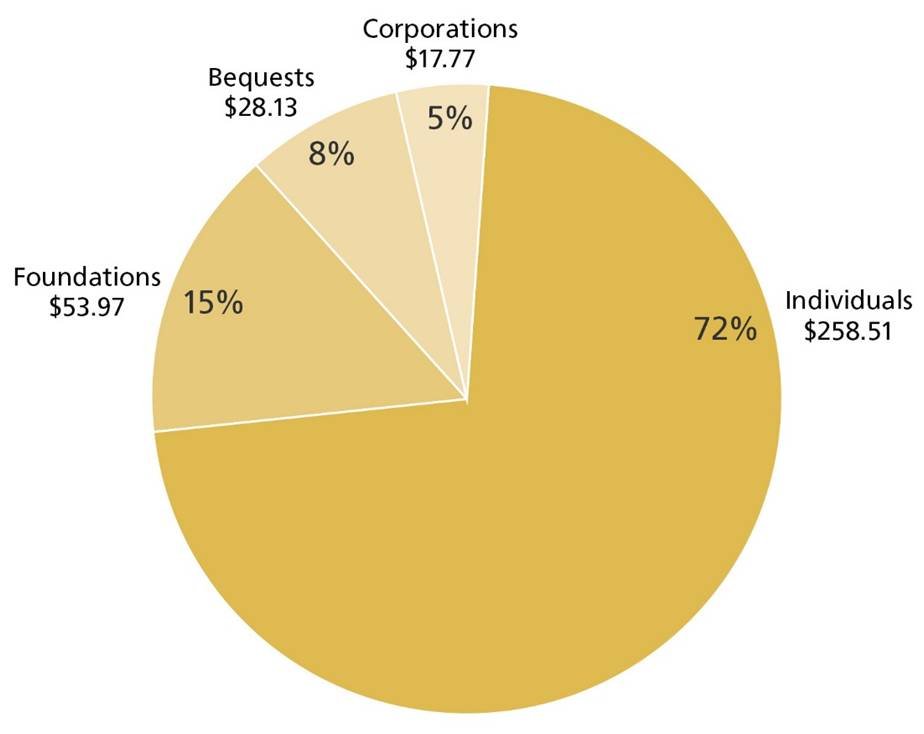 They fail to look at national giving trends that show individuals giving more than 70% of all contributed income and only 15% made by grants and foundations, with even less by corporations. It is these same organisations that continue